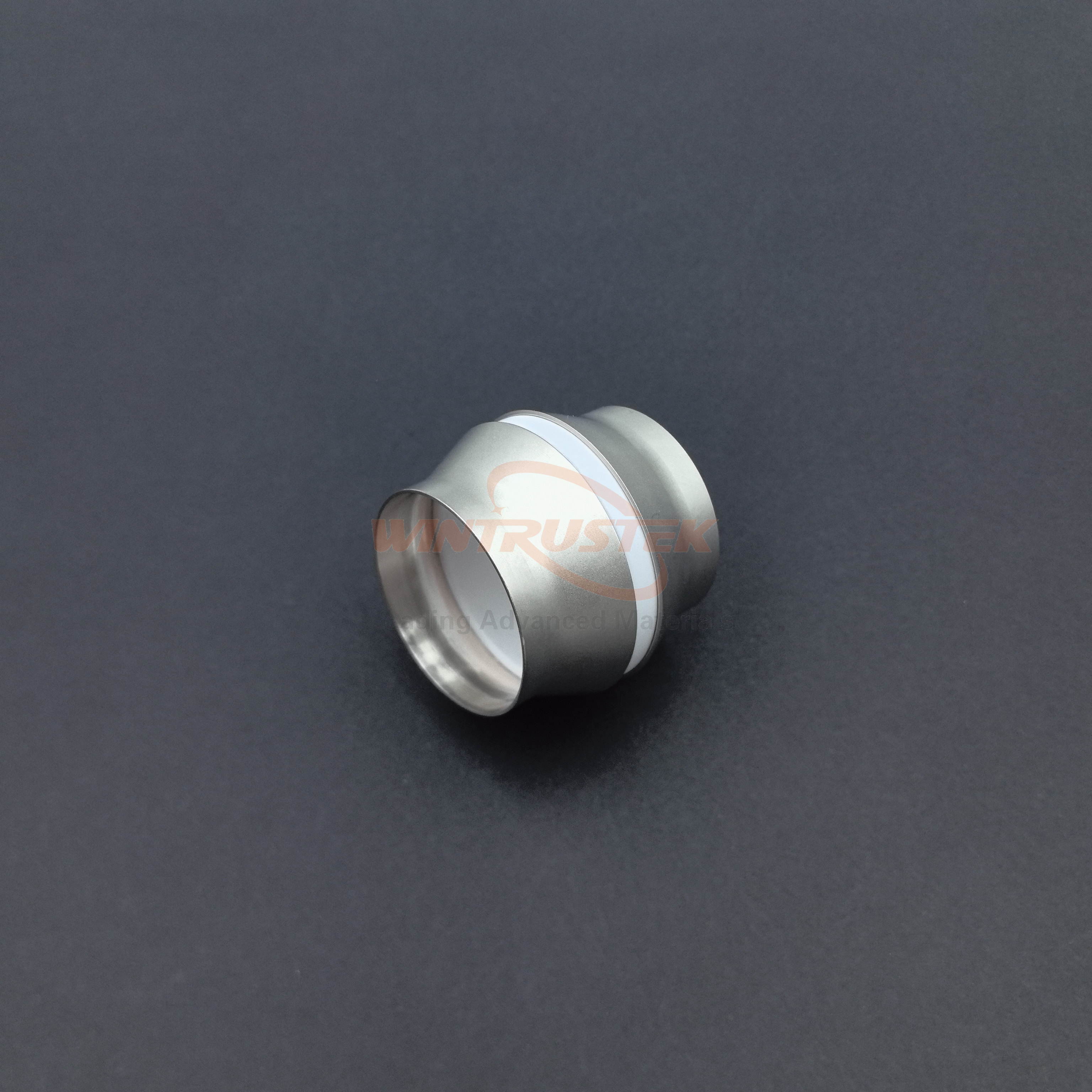
(Kovar to Alumina Part Produce by Wintrustek)
I. Overview of Kovar
Kovar is an iron-nickel-cobalt-based expansion alloy whose main feature is that its thermal expansion coefficient matches that of some hard glasses and ceramics (such as alumina) throughout a certain temperature range. This feature makes it an essential sealing material in electronic packaging, aerospace, lasers, and other industries. It is typically utilized to fabricate metal components for hermetic sealing with glass or ceramics.
The designation "4J" for precision alloys under China's national standard (GB) represents alloys having expansion characteristics "approaching" (J) a certain value.
II. Detailed Analysis of Three Kovar Grades
Commonality: All three are based on Fe-Ni-Co and have expansion properties similar to hard glass and ceramics. Thermal expansion curves, Curie temperatures, and mechanical characteristics vary significantly as a result of slight compositional changes.
1. 4J29 (the most classic and widely used Kovar)
Typical Composition: Fe-29Ni-17Co, with minor additions of deoxidizing elements like manganese and silicon.
Expansion Characteristics: Average linear expansion coefficient highly matched with DM-308 molybdenum-group glass and 92-96% alumina ceramics across the 20-450°C range.
Key Parameters:
Curie temperature: Approximately 430°C (loses ferromagnetic properties above this temperature).
Matching Materials: High-alumina ceramics, molybdenum-group glasses.
Surface Treatment: Typically requires nickel or gold plating to enhance brazability and corrosion resistance.
Primary Applications: Microwave tubes, lasers, integrated circuit housings, high-reliability relays, aerospace sealed connectors.
2. 4J33 and 4J34 (Improved Kovar)
These alloys are variants developed to address shortcomings of 4J29 (such as elevated low-temperature expansion coefficients), featuring higher Curie temperatures.
Composition Differences:
4J33: Fe-33Ni-14Co (reduced cobalt, increased nickel).
4J34: Fe-31Ni-15Co (composition intermediate between the two).
Expansion Characteristics: At room temperature to approximately 300°C, the coefficient of expansion is slightly lower than 4J29, offering better compatibility with certain specialty glasses or ceramics.
Key Advantage—High Curie Temperature:
4J29: ~430°C
4J33: ~500°C
4J34: ~480°C
Significance: A higher Curie temperature ensures the material remains non-magnetic at elevated operating temperatures, preventing magnetic interference with high-frequency, high-precision instruments.
Application Selection: Suitable for high-temperature environments or magnetically sensitive applications, or selected based on expansion curve matching tests with specific sealing materials.
III. Core Advantages of Brazing Kovar with Alumina Ceramics
Gas-tight hermetic sealing of Kovar and alumina ceramics via brazing is a vital technology in modern electronic packaging, with the following primary benefits:
1. Exceptional Thermal Expansion Matching (Fundamental Advantage)
When cooling from brazing to room temperature, the same contraction rates of both materials greatly reduce residual thermal stress at the joint. This successfully eliminates ceramic cracking and brazing seam fractures, resulting in maximum reliability.
2. Achieving High Gas Tightness
Helium leak rates in mature systems often fall below 1×10⁻⁸ Pa·m³/s for sealed components, effectively isolating external moisture and oxygen. This meets the severe dependability requirements for aerospace, military, and other high-demand applications.
3. Superior Mechanical Strength and Structural Integrity
Kovar provides strong mechanical support and toughness, while alumina ceramics give excellent insulation and hardness. Brazing these materials results in a robust composite structure with both protective and functional features.
4. Mature Processes and High Reliability
A consistent process chain has been constructed, which includes ceramic metallization (molybdenum-manganese technique), nickel plating, assembly with Kovar components, and vacuum/protective environment brazing. The process is highly controllable, suitable for mass production, and produces high yields with consistent quality.
IV. Summary Comparison and Selection Recommendations
Characteristics | 4J29 | 4J33 | 4J34 | The core advantages of brazing with alumina ceramic |
Core Features | Classic and versatile, offering the best cost-performance ratio | High Curie point, slightly lower low-temperature expansion | Performance Trade-offs | 1. Precise thermal expansion matching |
Optimal Matching | 92-96% Al2O3 ceramics | Specific glass/ceramic, unsuitable for magnetic fields | Specific glass/ceramic | 2. Extremely low residual stress |
Curie temperature | ~430°C | ~500°C | ~480°C | 3. High airtightness rating |
Selection Recommendations | The preferred choice for sealing most conventional alumina ceramics | High operating temperature, magnetic-sensitive, special matching requirements | Specific thermal expansion matching requirements | 4. Superior mechanical strength and reliability |
Mature manufacturing process | Highest | High | High | 5. Standardized process system |
Ⅴ. Conclusion
Within the Kovar family, 4J29 is the standard and recommended material for brazing high-alumina ceramics, providing a good balance of performance, cost, and dependability. 4J33/34 is a performance improvement for particular applications that require greater operating temperatures or rigorous nonmagnetic characteristics. The brazing of Kovar with alumina ceramics, which is supported by their thermal expansion matching, has become the industry standard for hermetic packaging of high-reliability electronic and optoelectronic components.