FORESPØRSEL
  • CVD as a Core Technology: From Process Fundamentals to the Performance Advantages and Application Value of PBN Products
    2026-04-23

    CVD as a Core Technology: From Process Fundamentals to the Performance Advantages and Application Value of PBN Products

    CVD technology provides a strong technical foundation for the development of advanced ceramic materials due to its high purity, strong controllability, and excellent structural characteristics. PBN products fabricated by CVD further transform these process advantages into material performance advantages, demonstrating significant value in high-temperature, high-vacuum, and high-cleanliness environ
    Les mer
  • Advantages and Industrial Applications of Mg-PSZ Ceramic
    2026-04-17

    Advantages and Industrial Applications of Mg-PSZ Ceramic

    Partial stabilization of zirconia (ZrO₂) with magnesium oxide (MgO) enhances toughness, strength, and thermal performance. Mg-PSZ has extensive applications in aerospace, energy, precision manufacturing, and biomedical fields.
    Les mer
  • Boron Nitride Nozzles for Metal Powder Gas Atomization
    2026-04-10

    Boron Nitride Nozzles for Metal Powder Gas Atomization

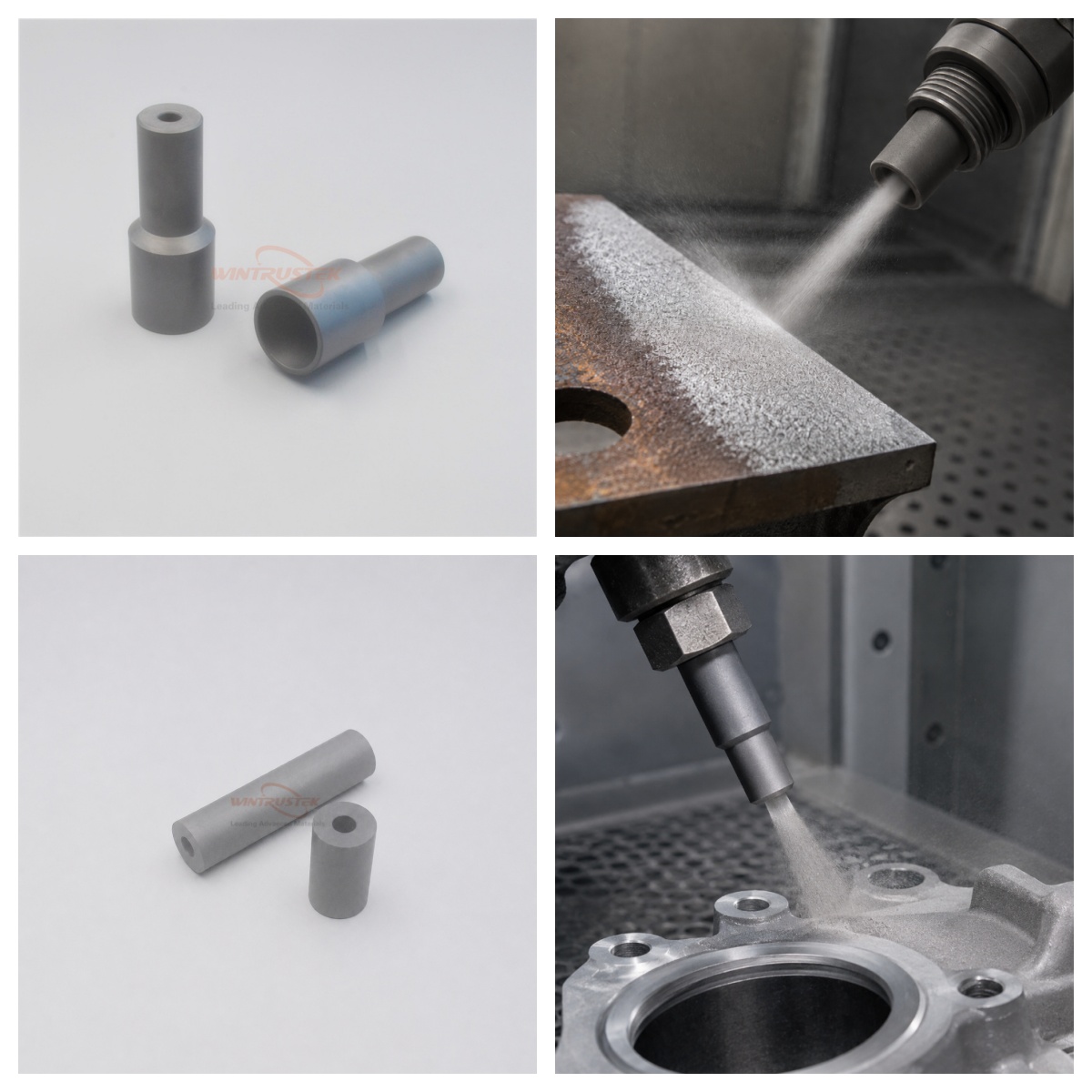
    For manufacturers facing frequent shutdowns caused by nozzle replacement and limited production continuity, boron nitride nozzles represent a meaningful material option. Their high-temperature resistance, thermal shock performance, chemical stability, and low wettability give them potential value in improving continuous operation, reducing maintenance intervention, and supporting more consistent p
    Les mer
  • Improving High-Temperature Furnace Durability with Proper Boron Nitride Ceramic Sleeves
    2026-04-03

    Improving High-Temperature Furnace Durability with Proper Boron Nitride Ceramic Sleeves

    High-temperature furnace durability depends on small components too. Read why boron nitride ceramic sleeves matter and how to select them based on real operating conditions.
    Les mer
  • How to Select the Right Silicon Carbide (SiC) Grade for Harsh Industrial Applications
    2026-03-27

    How to Select the Right Silicon Carbide (SiC) Grade for Harsh Industrial Applications

    Material selection should begin with the dominant failure mechanism. Understand the differences between RBSiC, SSiC, and porous SiC, then match properties to operating conditions—because material name alone does not guarantee performance.
    Les mer
  • The Hidden Risk in AlN Substrates: Why Consistency Beats Performance
    2026-03-20

    The Hidden Risk in AlN Substrates: Why Consistency Beats Performance

    Why 170+ W/mK AlN datasheets don't guarantee reliability in SiC power modules. This article reveals the hidden risks that surface during validation—batch inconsistency, flatness variation, density uniformity issues, and metallization mismatches. Learn what experienced engineering teams actually look for in AlN substrate suppliers: batch repeatability, transparent QC, and engineering-stage support.
    Les mer
  • Beryllium Oxide (BeO) Ceramics: Advantages, Applications, and Safety
    2026-03-16

    Beryllium Oxide (BeO) Ceramics: Advantages, Applications, and Safety

    Beryllium oxide (BeO) ceramics, with their unique combination of properties—high thermal conductivity, high electrical insulation, high-temperature resistance, and excellent nuclear properties—have secured important applications in these fields. Despite challenges in toxicity management, their comprehensive performance advantages ensure they retain significant research and application value under
    Les mer
  • Alumina Grinding Media for the Pharmaceutical Industry
    2026-03-06

    Alumina Grinding Media for the Pharmaceutical Industry

    Alumina grinding balls have become a popular grinding medium in the pharmaceutical industry due to their ultra-high hardness, excellent wear resistance, chemical inertness, and high purity, making them ideal for micronizing active pharmaceutical ingredients, formulation preparation, and biopharmaceutical research and development.
    Les mer
  • En introduksjon til keramisk metallisering
    2026-02-27

    En introduksjon til keramisk metallisering

    Keramisk metallisering er teknikken for å avsette et svært vedheftende metallbelegg på en keramisk overflate. Dette er et viktig skritt siden keramikk i seg selv er ufuktbare å lodde. Det metalliserte laget gjør dem loddbare, og gir det nødvendige grunnlaget for å danne sterke keramikk-til-metall-forbindelser.
    Les mer
  • Hvorfor erstatter keramiske substrater MCPCB-er i høyeffekts LED-applikasjoner?
    2026-02-06

    Hvorfor erstatter keramiske substrater MCPCB-er i høyeffekts LED-applikasjoner?

    Tradisjonelle kretskort med metallkjerne (MCPCB) har høy termisk motstand på grunn av det nødvendige polymerisolasjonslaget mellom metall- og kretslagene, noe som gjør dem i økende grad ute av stand til å møte varmespredningsbehovet til LED-er med høy effekt og ultrahøy effekt. Derimot kombinerer keramiske underlag isolasjon og termisk ledningsevne, og eliminerer termisk motstand mot grensesnitt
    Les mer
12345 ... 9 » Page 1 of 9
Copyright © Wintrustek / sitemap / XML / Privacy Policy   

Hjem

Produkter

Om oss

Kontakt