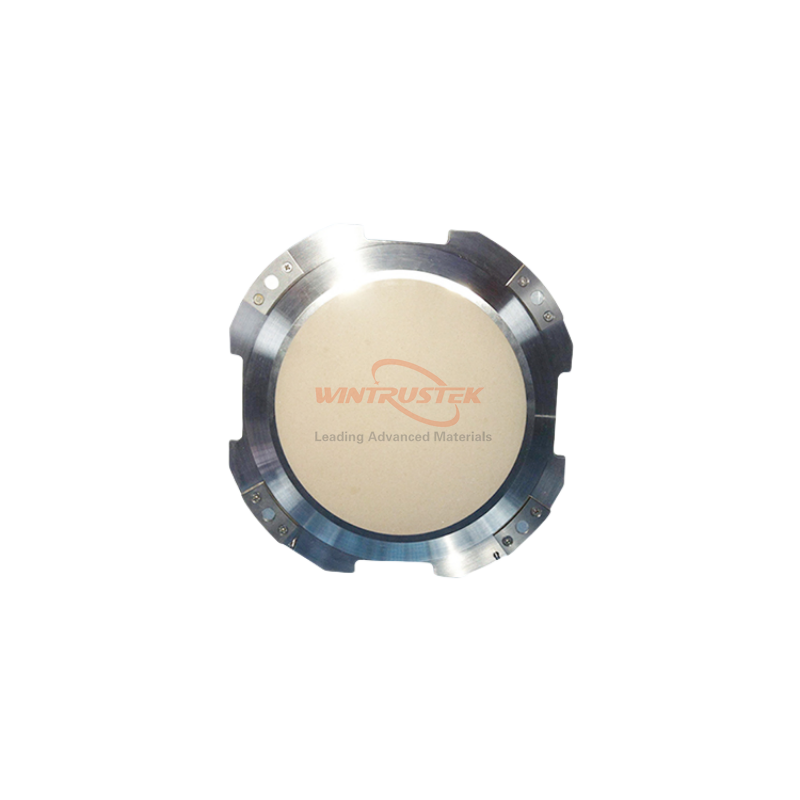
(Porous Alumina Ceramic Vacuum Chucks)
Porous ceramics are high-performance engineered materials that consist of a solid matrix and a predetermined architecture of empty micro-pores. The porous Alumina and Silicon Carbide (SiC) ceramics possess interconnected pore networks, high mechanical strength, thermal stability and chemical inertness, and are now indispensable in semiconductor production, chemical processing, environmental filtration and gas management systems.
Porous Alumina and Silicon Carbide are structurally stable, have exact pore geometries and are dimensionally stable despite extreme temperatures, high working pressures and direct contact with corrosive acids or alkalis; unlike organic polymer membranes or metallic porous media.
Porosity and pore size distribution must be precisely controlled to achieve the optimal combination of fluid permeability, structural strength and filtration efficiency. We design unique porous Alumina and SiC ceramic parts for microfiltration, even gas diffusion and accurate semiconductor vacuum chucking.
Here, a study of the design concepts of porous Alumina and SiC ceramics and their main industrial uses is presented.
1. Microstructure and Porosity Control: Fundamental Design Principles
The design of porous Alumina and SiC ceramics has to compromise between mechanical strength and fluid dynamic performance. Wintrustek engineers are concerned with four fundamental structural parameters:
Entire Porosity: The ratio of the pore volume to the entire volume of material; usually designed to be between 25 percent and 65 percent, depending on the purpose. more porosity means more permeability for fluids but lower structural load-bearing.
Pore Size Distribution (PSD): For the precision applications, the pore sizes should be maintained within a very narrow and uniform range (from sub-micron levels up to tens of microns). Gas diffusers to get a uniform bubble size . Liquid filters to get sharp cut-off limits .
Open Porosity and Interconnectivity: The open-cell porous architecture allow for smooth movement of fluids along interconnecting routes. Control of the particle size of raw Alumina and SiC and binder formulations allows for optimum open porosity with minimum flow resistance.
Tortuosity: Degree of difficulty of the fluid route through the ceramic matrix. Controlled tortuosity optimizes the depth filtering effectiveness without causing an excessive pressure drop through the system.
2. Major Applications for Porous Alumina and SiC Ceramics
A. Semiconductor Vacuum Chucks (Wafer Holders)
In semiconductor wafer inspection, polishing and lithography, silicon wafers must be maintained flat with no mechanical clamp that might create surface scratches or localized stress areas.
How It Works: Porous alumina and SiC vacuum chucks have a surface distribution of sub-micron size open pores. Atmospheric pressure holds the fragile wafer in place with a vacuum drawn underneath it.
Material Choice: Porous alumina has superior electrical isolation and good surface flatness. Due to its strong thermal conductivity and exceptional stiffness, porous SiC is an excellent choice for high temperature or rapid-thermal-processing conditions.
The Wintrustek Advantage: Wintrustek produces ultra-flat porous Alumina and SiC vacuum chucks with regulated sub-micron micro-pores, removing localized vacuum stress and eliminating wafer bending.
B. Diffusers and Spargers
The creation of fine homogeneous micro-bubbles for the incorporation of gasses into liquids is necessary in chemical reactors, water treatment aeration and semiconductor gas supply which is essential to maximize the gas-liquid contact area and mass transfer rates.
How It Works: A pressurized gas is forced through a porous Alumina or SiC ceramic disk or tube. The designed micro-pore network breaks the main gas stream into millions of micro bubbles.
Performance Gain : Porous Alumina and SiC generate far smaller bubbles than conventional metal spargers. They are also completely resistant to oxidation, ozone and strong acids.
C. Filtration of High-Temperature and Corrosive Liquids/Gases
In industrial exhaust purification or chemical liquid clarification, the temperature may be higher than 400 degrees Celsius or the environment may be aggressive acidic conditions where polymeric membranes melt and metals filters corrode.
How it works: Porous alumina and SiC filter elements collect particulate matter by trapping it on their exterior surfaces or within their tortuous pore channels.
Thermal Shock Resistance: Porous SiC has excellent thermal conductivity and low thermal expansion coefficient, hence it is the best material for high temperature gas filtration with frequent thermal cycling and backwashing.
Custom Porous Alumina and SiC Solutions by Wintrustek
From porous Alumina vacuum chucks for semiconductor wafer manufacturing to chemically inert SiC gas spargers or specialized ceramic filter components, Wintrustek offers full engineering support for your needs.
Our innovative production capabilities provide precise control of pore size, porosity levels and unique component geometries to satisfy your exact mechanical and fluid dynamic needs.
Reach out to us immediately at sales@wintrustek.com to speak with our technical team about your needs and seek unique porous ceramic solutions.